
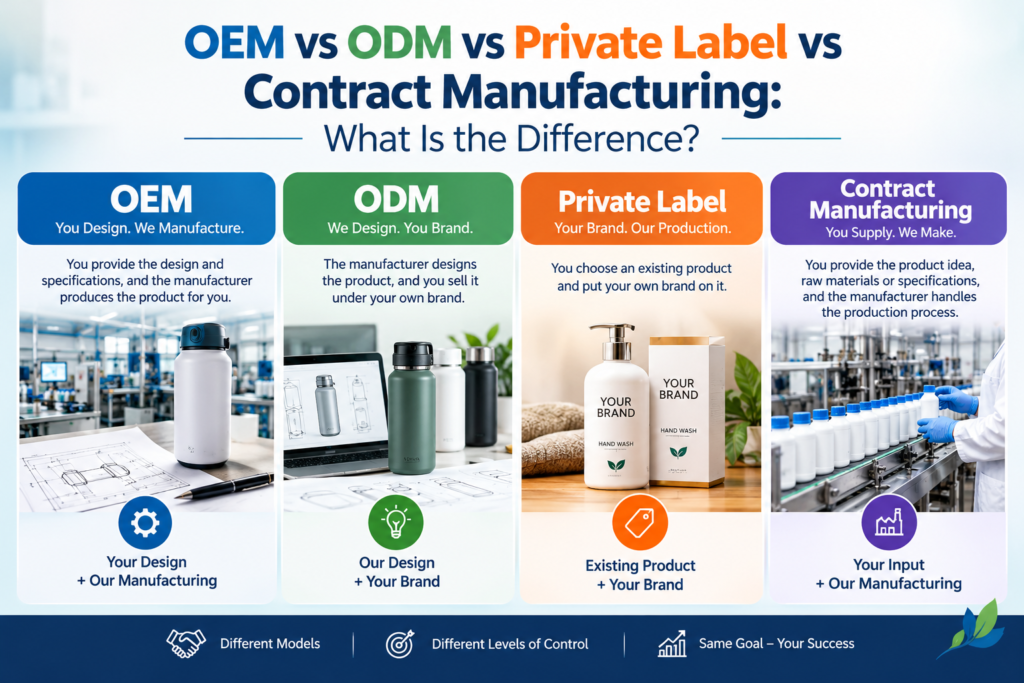
Businesses planning to launch food, beverages, supplements, cosmetics, personal care or other consumer products often come across terms such as OEM, ODM, private label and contract manufacturing. Although these models are sometimes used interchangeably, they represent different approaches to product development, manufacturing, customization and brand ownership.
Understanding the difference between OEM vs ODM vs private label vs contract manufacturing can help startups, distributors, retailers and established businesses select the right manufacturing model for their requirements.
What Is OEM Manufacturing?
OEM stands for Original Equipment Manufacturer. In an OEM arrangement, a manufacturer produces a product according to specifications, designs or requirements provided by the client.
The client generally has greater control over the product specifications, formulation, design or technical requirements. Depending on the industry, the manufacturer may handle production, processing, packaging and quality checks.
For example, a business may develop a specific nutritional formulation and approach an OEM partner to manufacture it according to the agreed specifications.
OEM manufacturing can be suitable for businesses that:
- Have an established product concept
- Require customized production
- Have specific formulation or technical requirements
- Want greater control over product specifications
- Plan to build a differentiated product portfolio
What Is ODM Manufacturing?
ODM stands for Original Design Manufacturer. Unlike a traditional OEM model, an ODM manufacturer may already have product designs, formulations or manufacturing expertise that can be adapted for a client’s requirements.
This model can reduce the amount of product development work required from the client.
An ODM arrangement may involve:
- Existing product concepts
- Manufacturer-developed formulations
- Product customization
- Packaging adaptation
- Production and quality control
- Commercial-scale manufacturing
ODM can be particularly useful for businesses that want to introduce products faster but do not want to develop every aspect of the product from the beginning.
What Is Private Label Manufacturing?
Private label manufacturing allows a business to sell a manufactured product under its own brand name. The manufacturing partner produces the product, while the client focuses on branding, marketing, distribution and sales.
Private label products can be developed using an existing formulation or, depending on the manufacturer’s capabilities, customized according to the client’s requirements.
This model is widely used across food, beverages, nutritional products, personal care and other consumer categories.
For example, businesses researching private label supplement companies India may be looking for manufacturers that can provide product development, manufacturing, packaging and private-label support.
Similarly, businesses exploring private label herbal supplements India may require herbal ingredients, suitable formulations, customized packaging and consistent production.
What Is Contract Manufacturing?
Contract manufacturing is a broader manufacturing arrangement in which one company contracts another company to manufacture products according to agreed specifications and commercial requirements.
The client may provide the product formula, specifications, packaging requirements or product concept, while the manufacturer manages production.
Contract manufacturing may include:
- Raw material sourcing
- Product formulation or processing
- Blending and manufacturing
- Quality checks
- Filling and packing
- Labeling
- Customized packaging
- Bulk production
Contract manufacturing is suitable for businesses that want manufacturing expertise and infrastructure without investing in their own production facility.
OEM vs ODM vs Private Label vs Contract Manufacturing
The easiest way to understand these models is to compare their level of customization, product ownership and manufacturer involvement.
| Manufacturing Model | Product Development | Customization | Brand Ownership | Typical Use |
| OEM | Client-led | High | Client | Customized products |
| ODM | Manufacturer-led | Medium to High | Client | Faster product development |
| Private Label | Existing or customized | Medium | Client | Own-brand products |
| Contract Manufacturing | Client/manufacturer agreed | Varies | Client | Outsourced production |
The exact structure can vary between manufacturers and industries, so businesses should always confirm the scope of services before signing an agreement.
What Is the Difference Between OEM and ODM?
The main difference between OEM and ODM is who takes greater responsibility for product development.
With OEM, the client generally provides more of the product specifications or requirements. With ODM, the manufacturer may already have product designs, formulations or technical solutions that can be adapted for the client.
OEM is generally better when:
You have a specific product specification and require greater customization.
ODM is generally better when:
You want to use an existing manufacturer-developed solution and bring it to market more efficiently.
What Is the Difference Between Private Label and Contract Manufacturing?
Private label focuses strongly on selling products under a client’s brand, while contract manufacturing describes the broader business relationship of outsourcing production.
A private-label product may be manufactured under a contract manufacturing arrangement.
For example, a company could approach a manufacturer, select or customize a product, apply its own branding and purchase the finished products for distribution.
This makes private label particularly attractive to startups, retailers, distributors, e-commerce businesses and companies expanding their product portfolios.
Which Manufacturing Model Is Best for Supplements?
Businesses entering the supplement industry often compare private label supplement companies India based on formulation capabilities, quality processes, packaging, MOQ, production capacity and customization options.
A company may choose private label when it wants to launch an existing or customizable supplement under its own brand.
Businesses looking for top private label supplement manufacturers India should not evaluate suppliers only on price. Important factors include:
- Product category expertise
- Raw material sourcing
- Formulation capabilities
- Quality control
- Testing procedures
- Packaging options
- Minimum order quantity
- Production capacity
- Documentation
- Lead time
- Customization support
Businesses searching for trusted private label supplement companies India should also assess whether the manufacturer’s capabilities match the exact product requirements.
Can the Same Model Work for Food and Beverage Products?
Yes. OEM, ODM, private label and contract manufacturing models can be applied to many food and beverage categories.
For example, a business interested in a Hot Chocolate Sachet Supplier India may require premix manufacturing, sachet packaging, customized branding and bulk supply.
A private-label arrangement can allow the business to market the hot chocolate sachets under its own brand while the manufacturing partner handles production and packaging.
The same principle can apply to premixes, beverages, spices, seasonings and other packaged food products, subject to applicable product and regulatory requirements.
How to Choose the Right Manufacturing Model
Before selecting OEM, ODM, private label or contract manufacturing, businesses should answer five important questions:
1. Do You Already Have a Product Formula?
If you already have a detailed formulation or specification, OEM or contract manufacturing may be suitable.
2. Do You Need Product Development Support?
If you need assistance developing the product, ODM or a manufacturer offering formulation support may be more appropriate.
3. Do You Want to Sell Under Your Own Brand?
If brand ownership and customized branding are priorities, private label can be an effective model.
4. How Much Customization Do You Need?
A standard product may require less development, while a differentiated product may require formulation, flavor, packaging or process customization.
5. What Is Your Expected Production Volume?
MOQ, production capacity and scalability should be considered before choosing a manufacturing partner.
What Should You Check Before Selecting a Manufacturer?
Choosing a manufacturing partner is an important business decision. Before placing an order, request clear information about:
- Manufacturing capabilities
- Product categories
- MOQ
- Production capacity
- Formulation support
- Quality-control procedures
- Packaging formats
- Testing requirements
- Lead times
- Commercial terms
- Customization options
- Documentation and applicable compliance requirements
Do not select a manufacturer based solely on the lowest quotation. Product consistency, communication, quality systems, scalability and reliability can have a significant impact on long-term business performance.
Why Choose the Right Manufacturing Partner?
The right manufacturing partner can help a business move from a product concept to commercial production without requiring the company to establish its own complete manufacturing infrastructure.
HI-JAS GOOD-LIFE PVT. LTD. provides manufacturing and packaging solutions across categories such as food and beverage, nutritional products, personal care and home care, with OEM, private-label and customized manufacturing support.
For businesses comparing private-label or contract manufacturing options, the ideal partner should be selected according to product requirements, manufacturing capability, quality expectations, packaging needs and future scalability.
Final Takeaway
The difference between OEM, ODM, private label and contract manufacturing mainly comes down to product development responsibility, customization, manufacturer involvement and the way production is managed.
OEM is suitable for businesses seeking greater control over product specifications. ODM can help businesses use existing manufacturer expertise and accelerate product development. Private label is ideal for companies that want to sell products under their own brand, while contract manufacturing provides a flexible way to outsource production.
Before choosing a model, compare customization, MOQ, quality control, formulation support, packaging, production capacity, lead time and commercial terms. A carefully selected manufacturing partner can provide the infrastructure and expertise needed to scale a product business efficiently.
Frequently Asked Questions
1. What is the difference between OEM and private label?
OEM generally involves manufacturing products according to specific client requirements, while private label focuses on producing products that are sold under the client’s own brand. The two models can overlap depending on the manufacturing agreement.
2. Is private label the same as contract manufacturing?
No. Private label describes the branded-product model, while contract manufacturing describes outsourcing production to another manufacturer. A private-label product can be produced through a contract manufacturing arrangement.
3. How do I choose private label supplement companies India?
Compare manufacturers based on formulation expertise, quality control, raw material sourcing, MOQ, packaging, testing, production capacity, documentation, customization and scalability rather than price alone.
4. Are private label herbal supplements India suitable for startups?
Private-label herbal supplements can be suitable for startups that want to build a branded product range without establishing their own manufacturing facility. Product formulation, applicable regulations, quality requirements and MOQ should be evaluated before production.
5. What should I check when choosing a Hot Chocolate Sachet Supplier India?
Check product quality, formulation, packaging options, customization, MOQ, production capacity, quality checks, lead time and bulk-supply capabilities. A supplier should be able to clearly explain the specifications and commercial terms of the product.